Dr Martin De Saulles is an author and technology analyst. He has written multiple books on the information economy, innovation, AI and digital sovereignty and is a contributing writer at CIO.com. He is a regular speaker at technology events and conferences.
Dr Martin De Saulles is an author and technology analyst. He has written multiple books on the information economy, innovation, AI and digital sovereignty and is a contributing writer at CIO.com. He is a regular speaker at technology events and conferences.
Dr Martin De Saulles is an author and technology analyst. He has written multiple books on the information economy, innovation, AI and digital sovereignty and is a contributing writer at CIO.com. He is a regular speaker at technology events and conferences.
Dr Martin De Saulles is an author and technology analyst. He has written multiple books on the information economy, innovation, AI and digital sovereignty and is a contributing writer at CIO.com. He is a regular speaker at technology events and conferences.
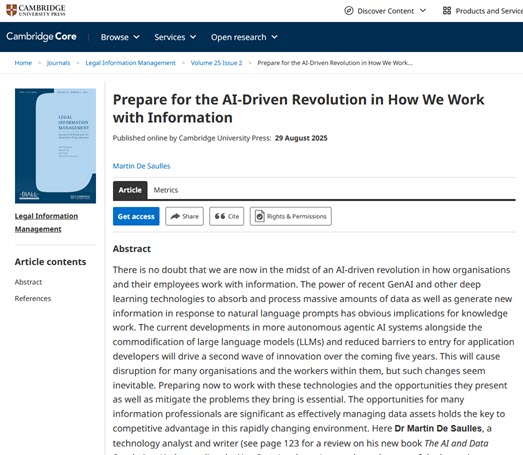
There is no doubt that we are now in the midst of an AI-driven revolution in how organisations and their employees work with information. The power of recent GenAI and other deep learning technologies to absorb and process massive amounts of data as well as generate new information in response to natural language prompts has obvious implications for knowledge work. The current developments in more autonomous agentic AI systems alongside the commodification of large language models (LLMs) and reduced barriers to entry for application developers will drive a second wave of innovation over the coming five years. This will cause disruption for many organisations and the workers within them, but such changes seem inevitable. Preparing now to work with these technologies and the opportunities they present as well as mitigate the problems they bring is essential. The opportunities for many information professionals are significant as effectively managing data assets holds the key to competitive advantage in this rapidly changing environment. Here Dr Martin De Saulles, a technology analyst and writer (see page 123 for a review on his new book The AI and Data Revolution: Understanding the New Data Landscape), goes through some of the key points relating to the evolution of AI in relation to those who work with information.
Dr Martin De Saulles is an author and technology analyst. He has written multiple books on the information economy, innovation, AI and digital sovereignty and is a contributing writer at CIO.com. He is a regular speaker at technology events and conferences.
Dr Martin De Saulles is an author and technology analyst. He has written multiple books on the information economy, innovation, AI and digital sovereignty and is a contributing writer at CIO.com. He is a regular speaker at technology events and conferences.
To provide the best experiences, we use technologies like cookies to store and/or access device information. Consenting to these technologies will allow us to process data such as browsing behaviour or unique IDs on this site. Not consenting or withdrawing consent, may adversely affect certain features and functions.
Functional
Always active
The technical storage or access is strictly necessary for the legitimate purpose of enabling the use of a specific service explicitly requested by the subscriber or user, or for the sole purpose of carrying out the transmission of a communication over an electronic communications network.
Preferences
The technical storage or access is necessary for the legitimate purpose of storing preferences that are not requested by the subscriber or user.
Statistics
The technical storage or access that is used exclusively for statistical purposes.The technical storage or access that is used exclusively for anonymous statistical purposes. Without a subpoena, voluntary compliance on the part of your Internet Service Provider, or additional records from a third party, information stored or retrieved for this purpose alone cannot usually be used to identify you.
Marketing
The technical storage or access is required to create user profiles to send advertising, or to track the user on a website or across several websites for similar marketing purposes.